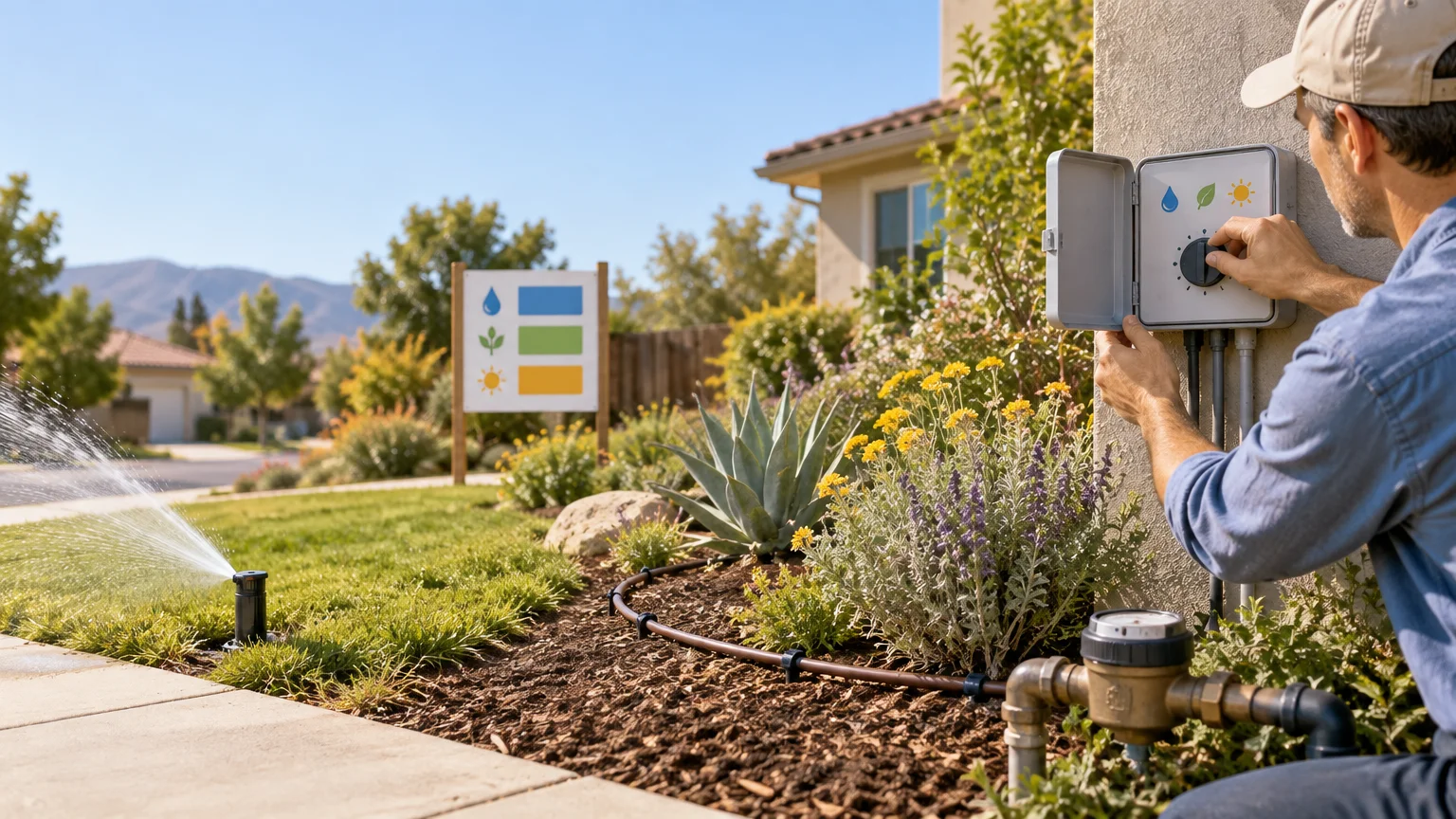
TLDR: Mandatory restrictions on outdoor watering usually deliver faster and larger reductions than voluntary appeals alone, especially where landscape irrigation represents a substantial share of demand. But water restrictions effectiveness depends on clear rules, public communication, compliance, enforcement, weather, and what residents were using before the restriction. The strongest approach combines an immediate limit with leak repair, irrigation adjustment, measurement, and long-term efficiency improvements.
Water restrictions can reduce urban demand during a drought, but no single savings percentage applies everywhere. A rule that sharply reduces irrigation in a hot, landscape-heavy community may have little effect in a place where households already use very little water outdoors. Restrictions should therefore be treated as short-term demand-management tools, not as a cure for drought or a substitute for water-supply planning.
Which water restrictions are usually most effective?
Rules tend to have the greatest immediate effect when they target a large, discretionary use that residents can identify and change. In many communities, that means lawn and landscape irrigation. Mandatory limits are generally more dependable than requests because they establish a common schedule or threshold and can be monitored.
Historical findings summarized by the California State Water Resources Control Board illustrate the range rather than establish a universal expectation. The digest cites studies associating rationing and use restrictions with reductions of 19% and 29%. It also describes a Los Angeles case in which mandatory watering restrictions combined with a price increase corresponded with a 23% reduction, compared with 6% under voluntary restrictions. Because pricing and restrictions changed together in the mandatory case, the result should not be credited to watering rules alone.
| Type of action | Speed of impact | Likely relative strength | Common limitation | Useful companion action |
|---|---|---|---|---|
| Voluntary conservation request | Fast to announce | Usually modest or inconsistent | Participation varies, and heavy users may make no change | Give residents a measurable target and show how to check bills or meters |
| Mandatory watering schedule | Fast | Moderate to strong where irrigation use is high | Water use may shift to permitted days instead of disappearing | Prohibit runoff and help residents reset controllers correctly |
| Waste, runoff, and overspray prohibition | Fast | Targeted but valuable | Requires reporting or field observation | Inspect broken heads, blocked spray patterns, and pavement watering |
| Household allocation or rationing | Moderate | Potentially strong | Needs fair baselines, exceptions, and reliable measurement | Provide leak assistance and a clear appeals process |
| Price signal or drought surcharge | Moderate | Varies by rate design and household response | Can create affordability concerns | Protect essential use while targeting unusually high consumption |
| Fixture and irrigation efficiency upgrades | Slower | Durable rather than purely immediate | Upfront cost and installation quality matter | Start with maintenance and low-cost adjustments before replacement |
This comparison is directional. Actual performance changes with climate, lot size, household composition, pre-restriction consumption, enforcement, prices, and other conservation programs operating at the same time.
Why drought rules often focus on outdoor watering
Outdoor irrigation is adjustable in a way that essential drinking, cooking, and sanitation are not. It is also visible: runoff, overspray, and watering at prohibited times can be identified more readily than many indoor uses.
California’s analysis for a 2022 emergency rule estimated that outdoor irrigation represented about 40% of the state’s urban water use. That is a California-specific estimate, not a figure to apply automatically to every state, city, or household. Even within one utility, an apartment resident with no landscape may have a very different savings opportunity from a detached home with turf and multiple irrigation zones.
Restrictions can also produce behavioral shifts rather than equivalent reductions. A peer-reviewed study examined hourly use from more than 82,300 single-family households in Fresno between 2013 and 2016. Tighter summer outdoor-watering schedules reduced use, but some irrigation moved into periods when watering remained permitted. The researchers also cautioned that simultaneous policies and persistent behavior changes make it difficult to isolate the effect of one conservation measure. Readers interested in the methodology can review the residential water conservation study.
This is why a watering-day rule is better viewed as a framework than a complete solution. If a household doubles every permitted irrigation cycle, some of the intended benefit disappears. A schedule works better when paired with limits on runoff, practical landscape guidance, controller adjustments, and feedback from a water bill or meter.
What makes restrictions work better?
Simple rules residents can verify
A useful notice answers five questions: When does the rule begin? Which addresses or customer groups water on which days? What hours are allowed? Which activities or systems are exempt? What happens after a violation? Residents should not have to interpret several overlapping announcements to determine whether they can run a sprinkler.
EPA WaterSense describes shortage plans that can progress from conservation requests to weekly watering limits and, at higher stages, restrictions on outdoor watering or pool closures. The exact stages and requirements remain local, so readers should consult their utility’s current notice rather than rely on a general drought summary. The EPA’s drought-awareness guidance provides a useful overview of staged responses.
Communication supported by monitoring
Utilities and property managers need to explain the rule before relying on penalties. Reminders at irrigation controllers, common-area notice boards, and maintenance work-order systems can prevent accidental violations. Clear communication is particularly important at rental properties, schools, and commercial sites where the person receiving the water bill may not be the person programming the controller.
Monitoring then shows whether the rule is changing demand. A household can compare gallons used with the same billing period from a prior year, while accounting for billing-cycle length, occupancy, rainfall, and unusual events. Where a meter is safely accessible and the utility permits customer readings, checking it before and after an irrigation cycle can provide faster feedback.
Maintenance and appropriate controls
Restrictions are easier to follow when the irrigation system works properly. EPA WaterSense recommends seasonal schedule adjustments, regular inspections, correction of leaks and overspray, and irrigation zones suited to the landscape. It also identifies weather-based and soil-moisture-based controllers as tools that can apply water according to conditions when they are properly selected, installed, programmed, and maintained.
A smart controller is not permission to ignore a local watering schedule. Its programming must still comply with current rules, and a sensor cannot repair a broken sprinkler head or correct water spraying onto pavement.
A household and property checklist
- Check the utility’s current drought stage, effective date, assigned watering days, allowed hours, exemptions, and enforcement process.
- Turn on each irrigation zone briefly and look for broken heads, geysers, clogged emitters, overspray, pooling, and runoff. Follow local testing exemptions if watering is otherwise prohibited.
- Correct visible leaks and redirect spray away from sidewalks, walls, driveways, and streets.
- Reset run times for the season rather than leaving a peak-summer schedule active all year. Avoid increasing run time merely because fewer watering days are allowed.
- Check whether rain shutoff, weather-based, or soil-moisture controls are installed, functional, and permitted under the local rule.
- Record a baseline from a recent bill or meter reading. Compare gallons per day, not just the total bill, because billing periods can have different lengths.
- Choose one durable improvement, such as repairing a valve, separating incompatible plants into different zones, replacing a malfunctioning controller, or reducing an area of high-water turf.
People looking for a manageable daily target can also use the measurement approach in this guide to saving 20 gallons a day. The important point is to verify the result rather than assume that completing a conservation task produced a particular savings figure.
Worked example: estimating irrigation affected by a schedule change
Consider a hypothetical system with six zones. Assume each zone averages 8 gallons per minute and runs for 10 minutes per watering day. If the system operates three days each week, the estimated weekly irrigation is:
6 zones × 8 gallons per minute × 10 minutes × 3 days = 1,440 gallons per week.
If a restriction reduces the schedule to two watering days and the run time remains unchanged, the arithmetic becomes:
6 zones × 8 gallons per minute × 10 minutes × 2 days = 960 gallons per week.
Under those assumptions, the difference is 480 gallons per week. This is an illustration, not a predicted household saving. Real sprinkler flow may differ by zone, and plant needs, soil, slope, rainfall, temperature, wind, distribution uniformity, leaks, and controller programming all affect the result. A household that compensates by increasing every run from 10 to 15 minutes would return to 1,440 gallons despite watering one fewer day.
For a better estimate, measure the actual zone flow where practical or use the property’s meter. Take a reading before and after a controlled irrigation cycle, subtract any simultaneous indoor consumption, and repeat under similar conditions. Stop the test if runoff begins; water flowing into the street is not evidence that the landscape needed a longer cycle.
Fairness matters in restriction design
Not every resident controls the equipment responsible for water use. Renters may be unable to reprogram a shared irrigation system, and employees may notice a leak without having authority to order a repair. Their practical first step is to document the location, time, and problem, then report it to the landlord, property manager, maintenance team, or utility according to local procedures.
Programs should also distinguish essential use from discretionary use and provide reasonable processes for medical needs, public health, newly established landscapes, food production, and other locally approved exceptions. Maintenance help and clear warnings can correct waste without assuming that every violation is intentional. Low-cost repairs and scheduling changes should generally be considered before residents are pushed toward expensive equipment.
How to interpret water-savings claims
A claimed percentage is useful only when its baseline and scope are clear. Ask whether it describes residential or total urban demand, whether it covers summer or a full year, and whether pricing, rebates, weather, enforcement, or public campaigns changed at the same time. Also ask whether the figure compares demand with the previous year, a modeled baseline, or a control group.
The responsible conclusion is not that every mandatory rule will save 20% or any other fixed amount. It is that well-designed mandatory limits can materially reduce outdoor demand, often more reliably than voluntary appeals, while the size of the result remains local and conditional.
The most useful next step
Follow the current local requirement first. Then use the restriction as a deadline for one lasting improvement: repair a leak, stop runoff, correct a controller schedule, measure an irrigation cycle, or reduce an area that needs frequent watering. Restrictions can deliver the immediate reduction a drought demands; maintenance and efficiency help keep some of that reduction after the emergency stage ends.